Cabinetry terms
A plain-language glossary of the words you'll hear while choosing cabinets, from face frames and overlay to finishes and hardware.
Parts of a cabinet
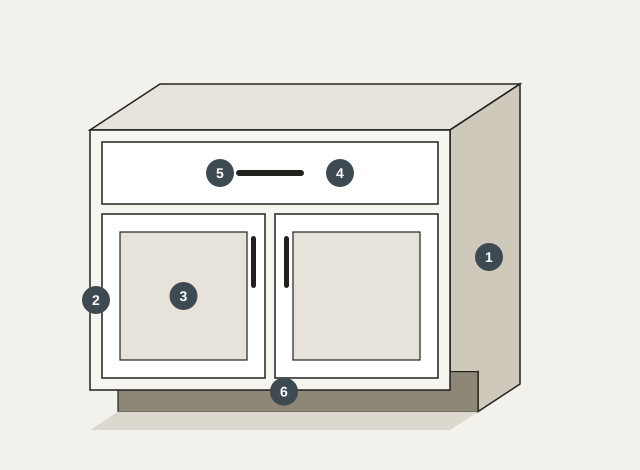
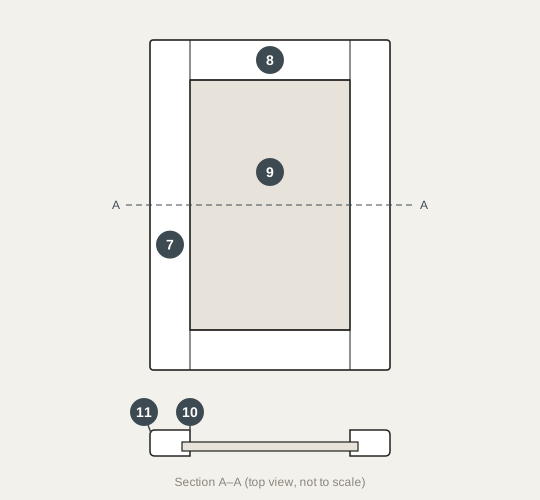
The pieces you'll hear named most often, on a base cabinet and on a Shaker door.
Case
The box of the cabinet: its sides, top, bottom and back. Also called the cabinet box or carcass.
Face frame
A frame of solid wood strips fastened to the front of the case on framed cabinets. Doors and drawers hinge to it or sit over it.
Door
The front that swings open. Most doors are either five-piece (a frame around a center panel) or slab (one flat piece).
Drawer front
The visible face of a drawer. It often matches the door, or uses a simple slab for contrast.
Hardware
The knobs and pulls you grab to open doors and drawers.
Toe kick
The recessed space at the bottom of a base cabinet that leaves room for your feet while you stand at the counter.
Stile
A vertical piece of a door's frame.
Rail
A horizontal piece of a door's frame, at the top and bottom and sometimes across the middle of a tall door.
Center panel
The panel held inside the door frame. It can be flat, raised, or replaced with glass.
Inner edge profile
The shape where the door frame meets the center panel. Shaker doors use a square edge; others use a bead, cove, ogee or bevel.
Outer edge profile
The shape cut along the outside edge of a door or drawer front, from square to softly rounded to detailed.
Cabinet types
The basic cabinets a kitchen or bath layout is built from.
Base cabinet
A cabinet that sits on the floor and holds up the countertop.
Wall cabinet
A cabinet that hangs on the wall, usually above the counter. Also called an upper.
Tall cabinet
A cabinet that runs from the floor toward the ceiling, used for pantry storage, brooms or a built-in oven. Also called a pantry or utility cabinet.
Sink base
A base cabinet with an open interior for the sink and plumbing. The top usually has a false drawer front, which is either fixed in place or tips out.
Drawer base
A base cabinet with a stack of drawers instead of doors.
Blind corner cabinet
A corner cabinet that extends behind the cabinet next to it, so part of its interior is hidden. Pull-out hardware makes that space reachable.
Lazy Susan cabinet
A corner base cabinet with round, rotating shelves.
Vanity
A base cabinet for a bathroom sink. Every cabinet line we carry offers vanities.
Appliance panel
A panel finished to match the cabinets that attaches to the front of a panel-ready refrigerator or dishwasher.
Island
A freestanding group of base cabinets with its own countertop, open on more than one side.
Construction and overlay
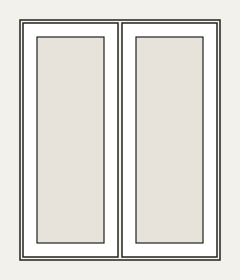
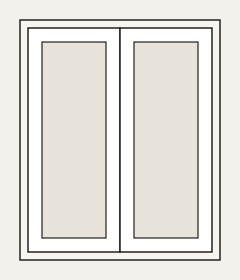
How the box is built and how the doors sit on it. Overlay changes the look of a kitchen more than most people expect.
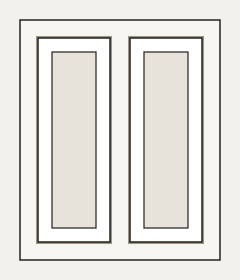
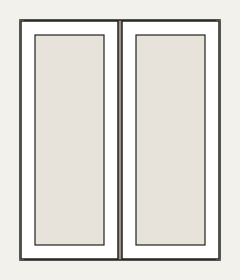
Framed cabinet
A cabinet with a face frame on the front of the case. The frame adds stiffness and gives hinges something to mount to.
Frameless cabinet
A cabinet with no face frame. Doors hinge directly to the case sides, which gives slightly wider openings. Also called full-access or European-style.
Full overlay
Doors and drawer fronts are sized to cover nearly all of the face frame, leaving small, even gaps between them. In our catalog, KCD Shaker, Brooklyn and Oslo and the Northville doors are full overlay.
Partial overlay
Doors cover only part of the face frame, so more frame shows between doors and drawers. Also called standard or traditional overlay. In our catalog, KCD Essential and Fabuwood Discovery and Metro are partial overlay.
Inset
Doors and drawer fronts sit inside the face frame, flush with its face, so the whole frame shows. It takes precise fitting and is a hallmark of traditional, furniture-style kitchens.
Reveal
The visible gap between doors, between drawer fronts, or between a door and the edge of the frame.
Five-piece door
A door built from four frame pieces (two stiles and two rails) around a center panel. Shaker and raised panel doors are five-piece doors.
Door styles
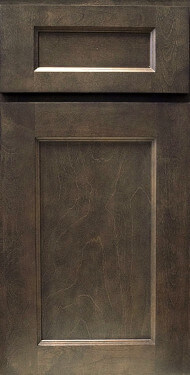
Examples are real doors from the manufacturers we carry.
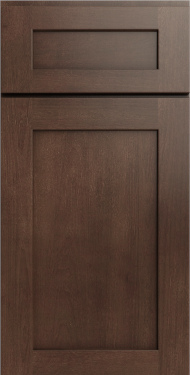
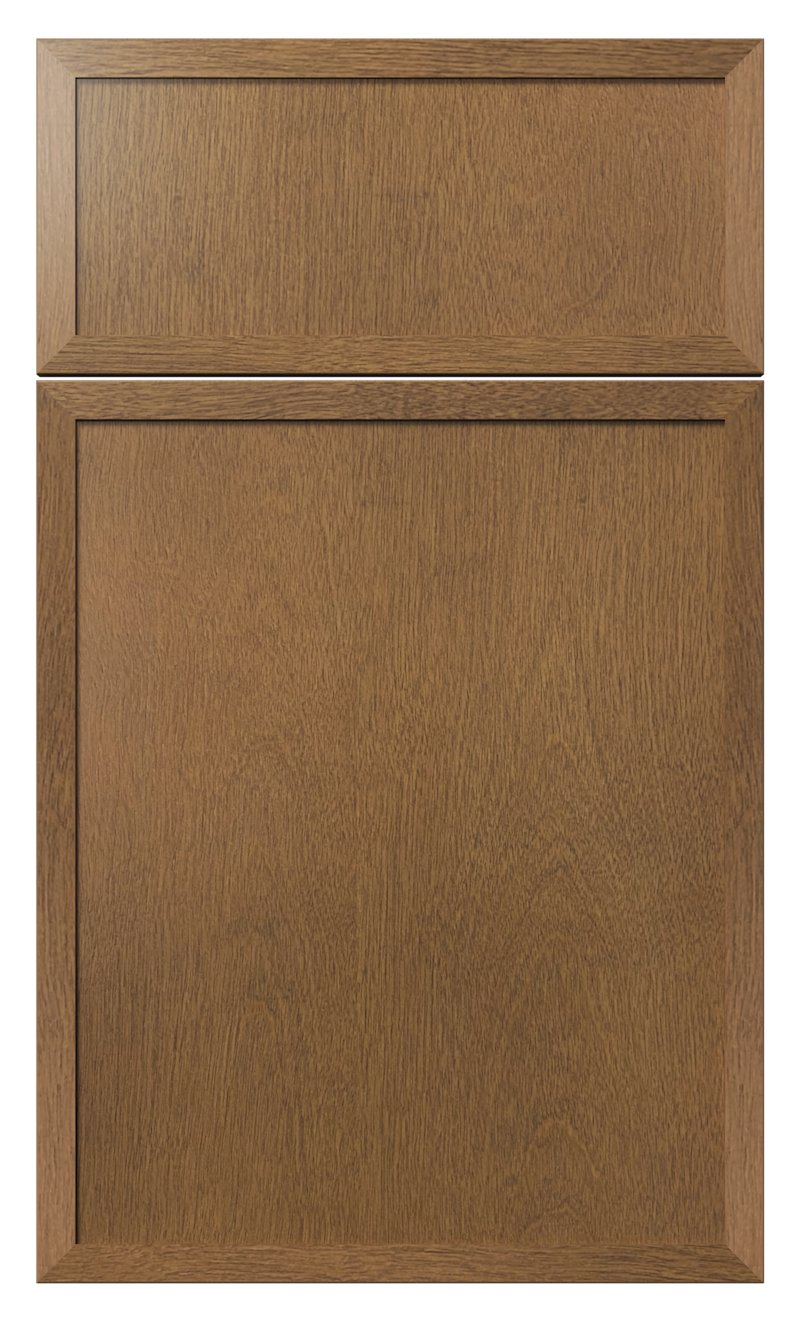


Shaker
A five-piece door with a flat, recessed center panel and square inner edges. The most common door style today, at home in both traditional and modern rooms.
Slim shaker
A Shaker door with narrower stiles and rails for a lighter, more modern look. Also called a skinny or micro shaker. Fabuwood Luna and Echo are examples.
Flat panel door
Any five-piece door whose center panel is flat and set back from the frame. Also called a recessed panel door. Shaker is a type of flat panel door.
Raised panel
A five-piece door whose center panel is thicker in the middle and shaped at its edges, so it rises toward you. Common in traditional kitchens.
Reverse raised panel
A solid wood center panel installed with its shaped side facing in, so the door looks flat from the front. J&K's B Shaker and S Shaker use this construction.
Slab door
A single flat piece with no frame and no separate center panel. Also called a flat slab. Common in contemporary kitchens and as drawer fronts.
Glass door
A door frame that holds glass in place of a center panel, often used to display dishes. Fabuwood offers framed glass doors and metal-framed glass doors.
Mullion door
A glass door divided into smaller panes by thin bars called mullions.
Joinery
How the pieces are held together. You'll see these terms in spec sheets and on drawer boxes.
Dovetail joint
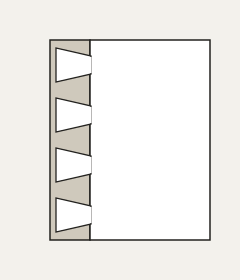
Interlocking, fan-shaped tails and pins that lock two boards together at a corner. Most often used on drawer box corners.
Mortise and tenon
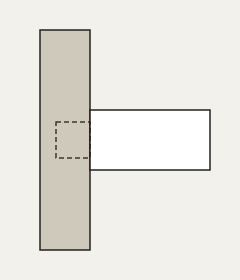
A tongue (the tenon) on one piece fits a matching slot (the mortise) in the other. A traditional way to join the rails and stiles of a door.
Mitered joint
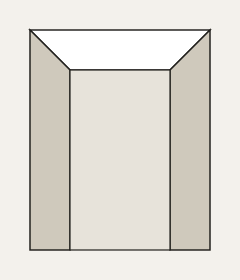
Two pieces cut at matching angles, usually 45 degrees, that meet at a corner like a picture frame. Hides the end grain.
Dowel joint
Round wooden pins glued into matching holes in both pieces.
Drawer box
The box behind the drawer front that holds what you store. It can be solid wood, plywood or another panel material.
Materials
What the boxes, doors and surfaces are made of.
Solid wood
Lumber cut directly from a tree. Used for face frames, door frames and some panels. It expands and contracts slightly with humidity.
Plywood
Thin layers of wood glued together with their grain alternating. A common material for cabinet boxes and shelves.
Particleboard
A panel of wood particles and resin pressed flat, usually covered with a melamine or veneer surface. Also called furniture board.
MDF
Medium-density fiberboard: fine wood fibers and resin pressed into a smooth, dense panel. It takes paint well, so it's common for painted doors and slab doors. KCD's Essential door is MDF.
Veneer
A thin slice of real wood applied over plywood, MDF or particleboard.
Melamine
A durable resin-saturated paper surface bonded to a panel. Common on cabinet interiors.
Thermofoil
A vinyl film heated and pressed over a shaped MDF door.
Laminate
A surface made of layers of paper and resin. High-pressure laminate (HPL) is pressed at higher pressure for more durability.
Acrylic
A high-gloss or matte plastic surface applied to slab doors, used in contemporary designs.
Finishes
How color and protection are applied.
Stain
Color that soaks into the wood and lets the grain show through.
Paint
An opaque color that covers the wood grain. On five-piece painted doors, fine lines can appear at the joints as the wood moves with the seasons.
Glaze
A translucent color brushed or wiped over a stain or paint so it settles into corners and profiles, adding depth.
Distressed
A finish deliberately marked, rubbed or worn to look aged.
Sheen
How much light a finish reflects, from matte through satin to gloss.
Factory finish
A standard color applied by the manufacturer before the cabinets ship.
Custom finish
A color mixed and applied to order, such as a custom paint match, instead of a standard factory color.
Clear coat
A transparent protective finish applied over wood or stain without adding color.
Storage and accessories
Inserts that make a cabinet easier to use.
Pull-out
Storage that comes out with the door or drawer in one motion, like a wastebasket pull-out.
Roll-out shelf
A shelf on glides behind a cabinet door. Open the door, then roll the shelf out to reach the back.
Lazy Susan
Round shelves that rotate, used in corner base cabinets.
Blind corner pull-out
Hardware that brings items from the hidden part of a blind corner cabinet into reach.
Tray divider
Vertical dividers that store baking sheets, trays and cutting boards on edge.
Spice pull-out
A narrow pull-out for spices and oils, often placed beside the range.
Drawer organizer
Dividers or an insert set inside a drawer for utensils, knives or other small items.
Trim and fillers
The finishing pieces that tie cabinets to the walls, floor and ceiling.
Filler
A strip that matches the cabinets and fills the gap between a cabinet and a wall or appliance, so doors and drawers can open freely.
Scribe molding
Thin trim shaped to follow an uneven wall, floor or ceiling and cover the gap.
Crown molding
Decorative trim along the top of wall or tall cabinets.
Light rail
Trim along the bottom of wall cabinets that hides under-cabinet lighting.
Finished end
The exposed side of a cabinet, finished to match its doors.
End panel
A separate panel applied to an exposed cabinet side, often to match the door style or extend to the floor.
Valance
A decorative piece that spans between wall cabinets, often over a sink or window.
Corbel
A decorative bracket that supports or appears to support a countertop overhang, shelf or hood.
Hardware
The moving parts that open and close your cabinets.
Concealed hinge
A hinge mounted inside the cabinet that can't be seen when the door is closed. Also called a European or cup hinge. Most adjust so doors can be lined up.
Soft-close
A damper that slows a door or drawer over its last few inches so it closes quietly instead of slamming.
Drawer glide
The hardware a drawer runs on. Also called a slide or runner.
Undermount glide
A drawer glide mounted under the drawer box, out of sight when the drawer is open.
Side-mount glide
A drawer glide fastened to the sides of the drawer box. It stays visible when the drawer is open.
Full extension
A glide that lets the drawer open all the way, so you can reach the very back.
Knob
A single-point grip for a door or drawer.
Pull
A handle fastened at two points. Also called a handle or bar pull.
Push-to-open
Hardware that opens a door or drawer when you press it, used for handle-free designs.
See it in person
Doors, finishes and hardware are easier to judge in hand. Visit the showroom by appointment, or work with a designer on your layout.